
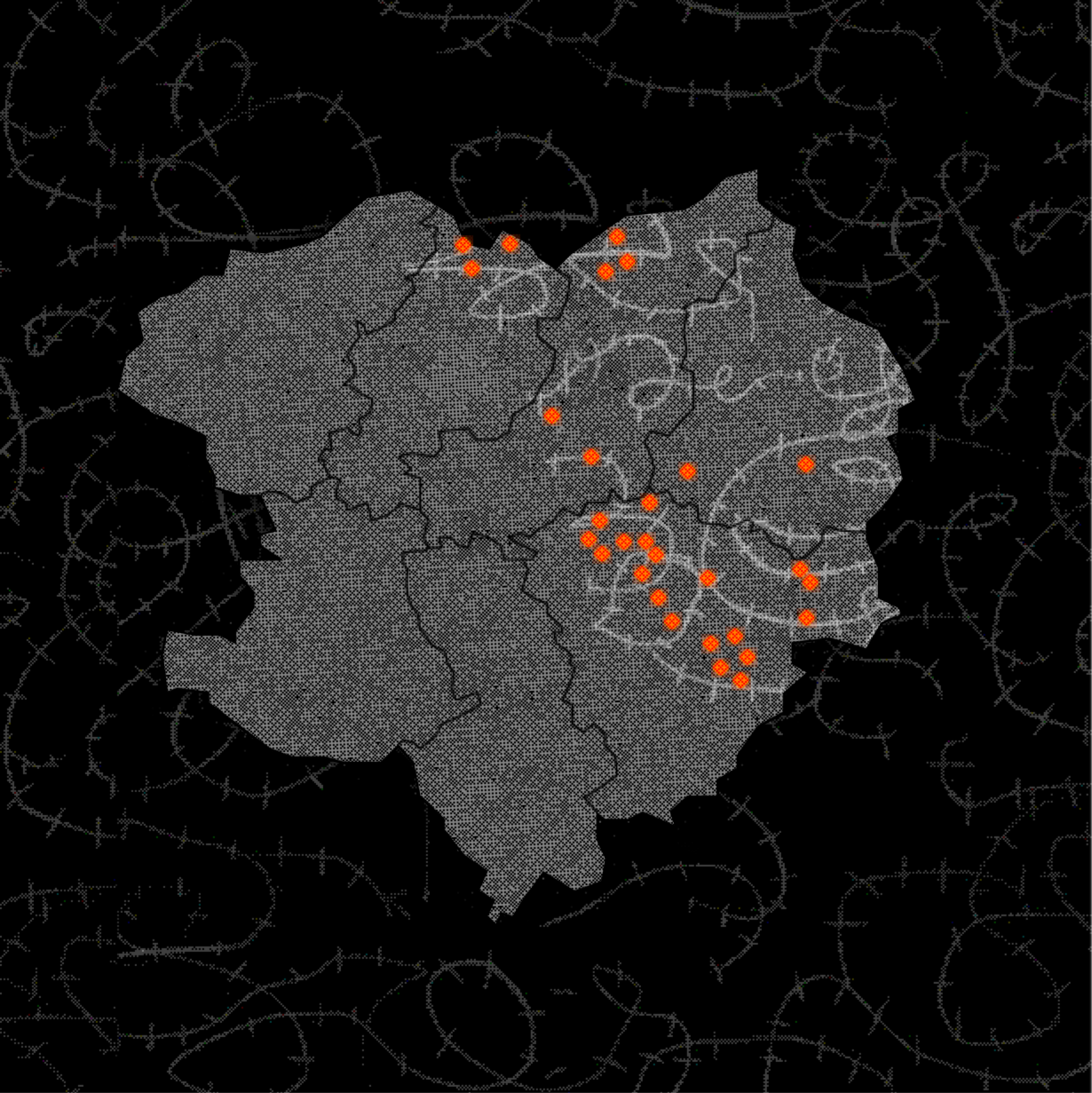
How can you understand what’s inside me if you weren’t there? [...] When you lie on the iron bed frame and they run 220 volts through it and pour water on you, and you lose control of your body—that’s when you’ll understand.
— Man detained in the Balakliia police station for almost two months
Organized Cruelty: Russia’s Detention and Torture Network in Kharkiv Oblast
Executive Summary
At the height of the 2022 occupation, Russian forces controlled about one-third of Kharkiv Oblast, most of which Ukraine retook during a September counteroffensive. Due to low local support in Kharkiv Oblast, Russian authorities struggled to establish a stable civilian administration during the occupation and relied on coercion, intimidation, and violence to consolidate control.
Civilians faced shortages of essential resources, disruption of services, and insecurity characterized by widespread repression and arbitrary detention. In this environment, Russian forces established a system of illegal sites across occupied Kharkiv Oblast to torture civilians and suppress resistance.
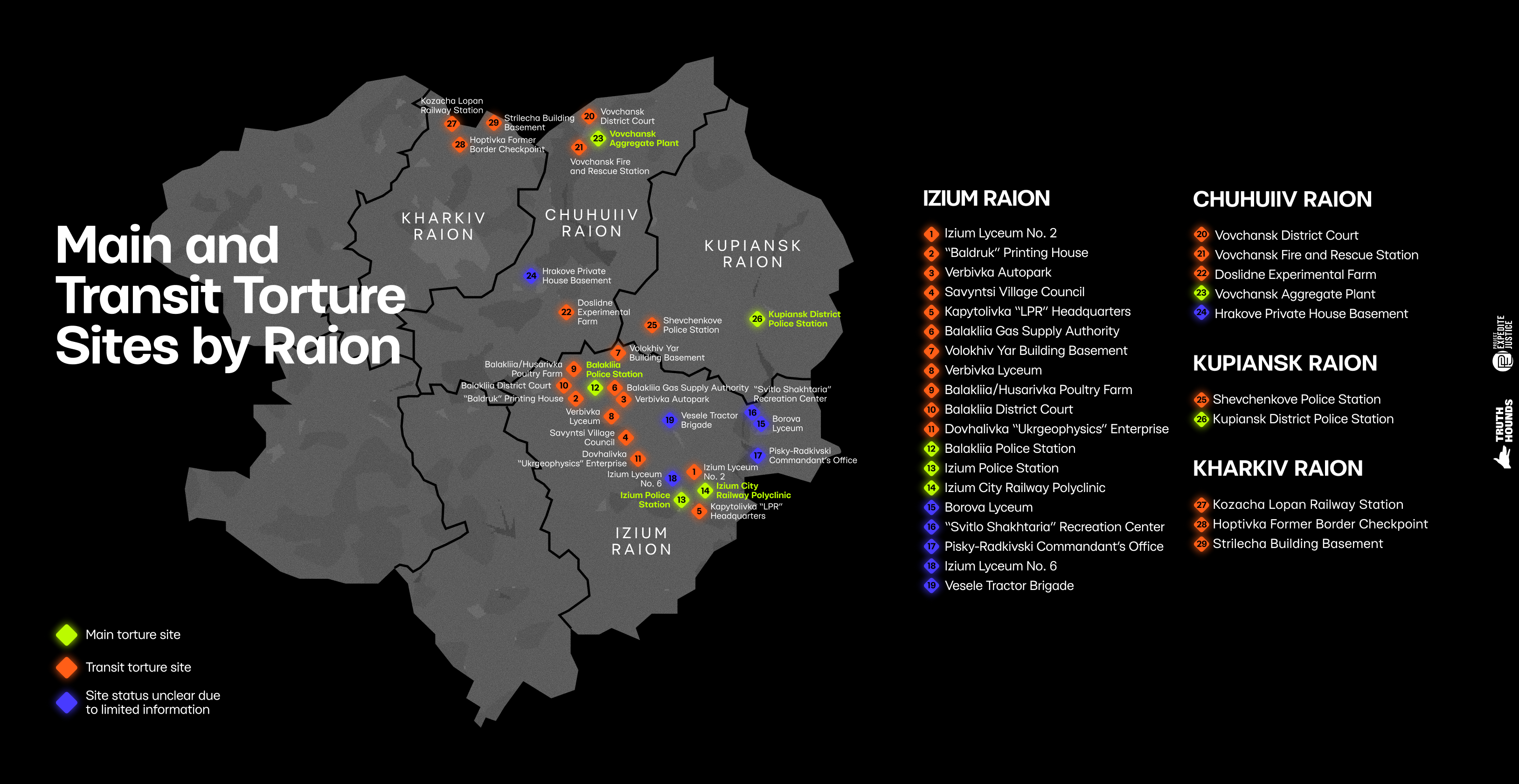
This report examines the establishment and operation of this detention and torture system, drawing on 114 survivor and witness testimonies, documentary evidence, and open-source investigations. The evidence reveals recurring patterns across 29 identified torture sites, including common structural and organizational features, profiling practices, interrogation methods, and torture techniques. Transit sites served as initial screening or holding cells for detainees before they were sent to larger facilities for further detention and torture.
Based on the available evidence, the report characterizes the documented acts committed by Russian forces as crimes against humanity in the form of imprisonment, torture, rape, and other forms of sexual violence. This characterization most accurately reflects the scale and scope of organization behind the violations committed by Russian forces in the occupied territory of Kharkiv Oblast.
Ukraine’s 2024 amendments to criminal legislation and the ratification of the Rome Statute (RS) may create important opportunities for accountability for Russia’s actions in Kharkiv Oblast in 2022. By adding crimes against humanity and command responsibility to domestic law, Ukraine has given domestic prosecutors stronger tools to address the organized and large-scale detention-related crimes documented in this report. The legal analysis supports future case-building by helping Ukrainian prosecutors assess potential charges of crimes against humanity. It may also assist prosecutors in other countries considering universal jurisdiction cases where domestic law allows.
The first chapter analyzes the Russian occupation of Kharkiv Oblast, highlighting the conditions that allowed Russian forces and occupation authorities to establish torture sites to control the civilian population. It shows how occupation authorities relied on detention, coercion, and violence to identify perceived opponents, extract information, suppress resistance, and compel collaboration.
The second chapter examines how Russian forces established and operated an organized network of torture sites across occupied parts of Kharkiv Oblast between February and September 2022. The chapter examines the network of sites for detention and torture that Russian forces established, the types of buildings they repurposed, their use of main and transit sites, and detainees’ transfer between locations. The chapter also identifies key categories of alleged perpetrators operating the network.
The third chapter examines the patterns of violence that Russian and occupation forces meted out in the sites. It documents instances of unlawful arrests, abuses during transfers and interrogations, inhumane detention conditions, repeated physical torture, sexual violence, and psychological coercion.
The fourth chapter assesses whether the collected evidence meets the Rome Statute’s requirements for crimes against humanity, analyzing the contextual elements of Article 7 and applying them to imprisonment, torture, rape, and other forms of sexual violence. Based on the available facts, the chapter finds that the abuses that Russian forces committed in torture sites across occupied Kharkiv Oblast followed repeated patterns and operated through organized structures.
The final chapter assesses the main accountability pathways relevant to the documented crimes and identifies the opportunities and limitations. It examines the potential avenues for holding alleged perpetrators accountable through domestic prosecutions in Ukraine, investigations and prosecutions by foreign authorities exercising universal or other extraterritorial jurisdiction, and proceedings before the ICC.
The documented violations demonstrate the need for accountability at both the individual and command levels. The findings and analysis underscore the importance of full accountability to deliver justice for survivors and affirm the Russian Federation’s responsibility for grave violations of international humanitarian law in Kharkiv Oblast.
Read in Ukrainian
Truth Hounds compiled this
report with the support of our donor.

This publication was produced with the generous support of the Howard G. Buffett Foundation. Its contents are the sole responsibility of Project Expedite Justice and Truth Hounds.
Recommendations
To the Office of the Prosecutor General of Ukraine, Ukrainian law enforcement agencies, and other national investigative authorities:
- Continue to investigate torture, unlawful detention, sexual violence, and other detention-related abuses in Kharkiv Oblast as part of a broader pattern of crimes, including possible crimes against humanity;
- Continue to consolidate evidence from torture sites to identify common methods, victim profiles, responsible units, chains of command, and links among facilities;
- Prioritize cases against those most responsible, including commanders, senior officials, facility heads, and others who ordered, facilitated, or failed to prevent abuses;
- Establish or strengthen multidisciplinary teams with prosecutors, investigators, analysts, forensic experts, and trauma-informed interviewers;
- Cooperate with foreign prosecutors by promptly sharing evidence relevant to universal jurisdiction and other extraterritorial proceedings, while protecting survivors and witnesses from retraumatization and security risks;
- Seek out and, where possible, provide specialized training for national and regional prosecutors and investigators on crimes against humanity, command responsibility, sexual violence, and trauma-informed interviewing.
To the Government of Ukraine:
- Provide the Office of the Prosecutor General of Ukraine, law enforcement agencies, and other competent investigative authorities with the resources, staffing, training, and technical capacity needed to investigate and prosecute detention-related crimes in occupied Kharkiv Oblast, including as possible crimes against humanity;
- Ensure that survivors of torture, unlawful detention, sexual violence, and other detention-related abuse have timely access to medical care, psychological support, rehabilitation, legal aid, and social assistance;
- Simplify access to official “civilian prisoner” status by providing clear guidance, free legal assistance, trauma-informed application support, written reasons for refusals, and meaningful opportunities to correct or supplement applications;
- Facilitate survivor access to the Register of Damage for Ukraine by ensuring that survivors of torture, unlawful detention, sexual violence, serious personal injury, and deprivation of liberty receive clear information about relevant claim categories, documentation requirements, evidence preservation, and available legal or civil society support;
- Consult survivors and survivor-led organizations when designing or reforming support programs and reparations measures.
To foreign governments and national criminal justice authorities able to exercise universal jurisdiction or other extraterritorial jurisdiction:
- Open structural investigations, including under universal jurisdiction where available, into torture, unlawful detention, sexual violence, enforced disappearance where supported by evidence, and other serious abuses committed in occupied Kharkiv Oblast;
- Investigate these abuses as possible crimes against humanity where the evidence supports the contextual elements, including their systematic or widespread character;
- Prioritize cases against those most responsible, including commanders, senior officials, facility heads, and others linked to the operation of torture sites;
- Cooperate with Ukrainian authorities to preserve, collect, and share relevant evidence, including survivor and witness testimony, medical and forensic documentation, and open-source material;
- Fund documentation, forensic analysis, witness protection, rehabilitation, legal aid, psychosocial support, and community-based services;
- Call on the Russian Federation to release all unlawfully detained Ukrainian civilians, including individuals held in torture sites across Kharkiv Oblast;
- Facilitate access to asylum or temporary protection for survivors or witnesses at risk of reprisals.
To the European Commission, the European External Action Service, and the EU Delegation to Ukraine:
- Provide sustained funding to strengthen Ukraine’s capacity to investigate and prosecute crimes against humanity, including torture, unlawful detention, and sexual violence;
- Continue to fund practical training for Ukrainian prosecutors and investigators on crimes against humanity, command responsibility, linkage evidence, and case-building against senior perpetrators;
- Support long-term rehabilitation, legal aid, psychosocial care, and social reintegration programs for survivors of torture and unlawful detention, including through Ukrainian civil society and survivor-led organizations.
To the International Committee of the Red Cross (ICRC):
- Continue to seek prompt, regular, and unhindered access to all Ukrainian civilians detained by Russian authorities, including in occupied territories and inside the Russian Federation;
- Continue efforts to register detainees, monitor their treatment and conditions, facilitate family contact, and seek information about the fate and whereabouts of missing or detained civilians;
- Raise concerns about denial of access, torture, ill-treatment, and unlawful detention with the relevant authorities in line with the ICRC’s mandate and working methods.
To United Nations bodies, including the UN Secretary-General, OHCHR, and the Special Rapporteur on Torture:
UN Secretary-General
- Appoint or mandate a dedicated senior United Nations focal point on torture and ill-treatment in Ukraine to coordinate system-wide action on prevention, detainee access, accountability, survivor rehabilitation, and redress;
- Press the Russian Federation to disclose the fate and whereabouts of detained Ukrainian civilians and to grant UN and ICRC monitors prompt, regular, and unhindered access to all torture sites;
- Ensure that UN reporting on Ukraine continues to address unlawful detention, torture, sexual violence, and enforced disappearance where supported by evidence, and denial of access to detainees.
OHCHR
- Expand monitoring and public reporting on detention-related abuses in occupied areas of Kharkiv Oblast, including through remote documentation where access is denied;
- Document detention locations, victim profiles, methods of torture, alleged units or officials involved, and chains of command;
- Publicly call for the immediate release of unlawfully detained civilians and for independent access to all places of detention.
UN Special Rapporteur on torture and other cruel, inhuman or degrading treatment or punishment
- Issue a public statement on torture and other ill-treatment of civilians in Kharkiv region during Russia’s 2022 occupation and request a follow-up country visit to Ukraine, including Kharkiv region, to gather survivor testimony, assess documentation and rehabilitation needs, and reinforce calls for accountability and reparations;
- Recommend that the Secretary-General designate a senior United Nations focal point on torture and ill-treatment in Ukraine to coordinate system-wide action on prevention, detainee access, accountability, survivor rehabilitation, and redress;
- Seek information from the Russian Federation and Ukraine concerning allegations of torture and ill-treatment of civilians in Kharkiv Oblast and other occupied areas.
- Urge Russia to release unlawfully detained civilians, disclose detainees’ whereabouts, and ensure access to legal counsel, medical care, family contact, and independent monitors.
UN Working Group on Arbitrary Detention and the Working Group on Enforced or Involuntary Disappearances
- Use available procedures to address arbitrary detention and enforced disappearance of Ukrainian civilians in Russian custody or in occupied territories;
- Seek information on detainees’ whereabouts, legal status, conditions of detention, transfers, releases, and deaths in custody;
- Call for the release of unlawfully detained civilians and for effective remedies for survivors and their families.
UN treaty bodies, including the Committee against Torture and the Human Rights Committee
- Use reporting, complaint, inquiry, and follow-up procedures to maintain scrutiny of torture, arbitrary detention, and related violations committed in the occupied areas of Ukraine;
- Support recommendations for survivor-centered remedies, including rehabilitation, recognition, compensation, and access to justice.
To the International Criminal Court (ICC):
- Prioritize the investigation and prosecution of detention-related crimes such as torture, unlawful imprisonment, and sexual violence as part of crimes against humanity investigations in Ukraine.
To Ukrainian and international NGOs and civil society organizations:
- Continue documenting torture, unlawful detention, sexual violence, enforced disappearance, and other detention-related abuses using trauma-informed and survivor-centered methods;
- Preserve survivor and witness testimony, forensic documentation, open-source material, and other evidence that may support domestic or international accountability efforts.
- Support survivors in accessing legal aid, medical and psychological care, social services, and official “civilian prisoner” status;
- Coordinate referrals to reduce duplication and avoid retraumatization of survivors, and ensure that undocumented or isolated survivors can access assistance.
- Support survivor-led organizations and include former detainees in the design of advocacy, assistance, and accountability initiatives.
To the Russian Federation:
- Immediately end torture, enforced disappearance, unlawful detention, and other ill-treatment of Ukrainian civilians and release all Ukrainian civilians unlawfully detained by Russian authorities or affiliated forces, including those held in occupied territories and inside the Russian Federation;
- Disclose the names, whereabouts, and legal status of all Ukrainian civilians in Russian custody or custody of affiliated forces;
- Ensure that detainees have access to family contact, legal counsel, medical care, and independent monitoring;
- Grant UN and ICRC personnel prompt, regular, and unhindered access to all places where Ukrainian civilians are or may be detained.
Methodology
This report examines the findings of TH and PEJ’s joint investigation into atrocities committed across occupied parts of Kharkiv Oblast from February to September 2022, drawing on documentation of survivor and witness testimony, open-source investigation, and analysis of existing reports and datasets. TH and PEJ had separately documented various aspects of Russia’s occupation in Kharkiv Oblast previously, so this report builds on and extends that earlier work.
The evidence base and methodology for this report are described below.
First-Hand Testimonial Evidence
Since September 2022, PEJ and TH have conducted a series of field missions to Kharkiv Oblast, Ukraine, collecting the testimonies of individuals who had either witnessed or personally endured torture or other detention-related abuses during the occupation of the region. As a result, PEJ and TH ultimately directly collected testimonies from 106 individuals whose accounts contained sufficient detail and could be adequately assessed in accordance with the project’s methodological standards.
The 106 individuals were survivors and witnesses of torture or other detention-related abuses. These categories are not mutually exclusive, as some survivors also reported witnessing acts of torture or other abuses committed against other detainees. Seventeen were female and 89 were male. Truth Hounds also conducted 12 follow-up interviews with previously interviewed survivors in order to understand the long-term consequences of the atrocities they endured and have had on their health and lives¹.
PEJ and TH used a mixed sampling approach, combining participant referrals with identifying potential interviewees during field missions. Through referrals, individuals who had already been interviewed, or who were known to the field researchers, helped identify others who had survived or witnessed detention-related abuses. In many localities, field researchers also identified interviewees directly by speaking with residents in areas where detention and torture had reportedly taken place. We prioritized interviewing respondents who had not been interviewed by other actors at the time of documentation.
All interviews took place in Ukrainian or Russian, following a semi-structured approach and with the informed consent of participants.
In 10 instances, PEJ and TH relied on information, including eight interview protocols provided by Ukrainian law enforcement agencies, which arose from PEJ’s broader cooperation with the Kharkiv Regional Prosecutor’s Office and the Main Investigation Department of the National Police in Kharkiv Oblast. In two OSINT requests to PEJ, state investigators identified facts relevant to ongoing investigations and requested PEJ’s technical support to collect and analyze open-source information. PEJ received permission to use this information from those requests and protocols in this report. PEJ and TH assessed all such materials alongside evidence collected independently.
Dataset and Investigative Findings
PEJ and TH collected the information and analytical data presented in this report primarily through their own research and investigations.
PEJ and TH consolidated all leads for this report in a joint, case-specific dataset. The dataset contains testimonies from 106 survivors and witnesses whom TH and PEJ interviewed directly, the eight interview protocols, and the two OSINT requests from Ukrainian law enforcement agencies mentioned above. Some direct survivors also provided information about other people whom they personally saw detained and tortured, or about whom they heard from third parties. TH and PEJ did not base this report on those indirect accounts. However, those accounts concern more than 250 additional survivors².
To protect survivors, witnesses, and their relatives, this report withholds the names and identifying details of interviewees. Names that appear in quotes are pseudonyms used to preserve confidentiality.
Open-Source Intelligence (OSINT) Analysis and Monitoring
Open-source materials significantly informed the report and were used, where relevant, to complement testimonial evidence and corroborate information from multiple sources. PEJ and TH relied on publicly accessible materials, including photographs, social media content, and other online sources, to support the reconstruction of events and patterns across torture sites.
In addition, PEJ and TH monitored open sources on an ongoing basis, reviewing Russian, Ukrainian, and international media, as well as official statements, to maintain contextual understanding and support the chronology of events in Kharkiv Oblast.
PEJ and TH also used OSINT to identify Russian units, whose members may have been involved in the detention and torture of civilians, as well as individual perpetrators. For reasons of confidentiality and to protect the integrity of the criminal proceedings, this report does not publish that information. It has instead been shared directly with the relevant investigative authorities.
Desk Research
The report also draws on desk research and a review of existing public reporting by international organizations, human rights bodies, civil society organizations, media sources, and academic literature. This included, for example, OHCHR reporting on the human rights situation during the Russian occupation of Ukrainian territory and its aftermath, which expressly covers occupied areas of Kharkiv Oblast, as well as OHCHR’s thematic report on detention of civilians in the context of the Russian Federation’s armed attack against Ukraine, which documents arbitrary detention, enforced disappearance, torture and ill-treatment, and related abuses in Kharkiv and other regions. These sources helped contextualize the report’s testimonial evidence and situate the findings from Kharkiv Oblast within broader documented patterns of detention-related abuse in occupied areas of Ukraine.
Site Identification and Analytical Framework
The information presented in this report relies mainly on semi-structured interviews, as well as closed-source³ and open-source information.
To assess all potential sites discussed during the interviews, PEJ and TH developed four key criteria to determine whether a specific facility could be identified as a torture site. These criteria account for the different types and levels of evidence available, including both widely documented locations and sites for which information remains more limited or fragmented.
The site-identification criteria are:
- Structural setup: The site must consist of a building or a detention facility, or parts of such structures, that Russian forces modified to detain individuals and subject them to torture.
- Operational setup: The site must show signs of an internal organizational structure, such as a chain of command or a formal or informal hierarchy. The available evidence should give reasonable grounds to believe that the alleged perpetrators held distinct roles, such as guards, interrogators, registrars, and facility heads.
- Period of operation: The facility must have operated on a sustained basis, rather than only on an ad hoc basis.
- Systematic nature of torture: The location must demonstrate that Russian forces carried out torture systematically against the same individuals or different persons, rather than as an isolated event. However, sites were not automatically excluded solely on the basis of survivors’ describing a single incident of torture or torture as an isolated occurrence. When supported by sufficient contextual and corroborating evidence, such sites were also considered for inclusion in the report.
TH and PEJ applied the criteria holistically, considering the combined weight of the available evidence rather than treating each criterion as a separate threshold for inclusion.
For analytical purposes, TH and PEJ also classified the sites to reflect their functions within the broader system of detention and torture. Most fall into two categories — main torture sites, used for sustained detention and systematic interrogation, and transit torture sites, used to screen and briefly hold civilians during identity or affiliation checks before they are released or moved on. To classify a site into one of these categories, we relied on the following criteria, assessed together rather than as strict, individually mandatory conditions. Where the available evidence confirmed that a location was a torture site but did not allow a confident assignment to either function, the site was recorded as status unclear.
TH and PEJ identified 18 transit torture sites based on the following criteria:
- Organizational setup: The site was not adapted or repurposed for the long-term detention of a large number of people. Relevant factors included whether the site had sufficient cells, toilets, and other facilities;
- Purpose of detention: Russian forces used the detained civilians in transit torture sites after stopping them in public places, checking their identity, and verifying whether they appeared on Russian Armed Forces lists; and
- Duration of detention: The period of detention in transit torture sites was relatively short, usually under 10 days.
Limitations
The sections documenting the establishment and operation of torture sites rest primarily on witness and survivor testimonies. The nature of these sources carries inherent limitations that should be acknowledged.
TH and PEJ conducted single-round interviews with the vast majority of interviewees. In many instances, follow-up interviews were not feasible due to timing and other constraints. For example, some survivors and witnesses expressed a preference not to be re-contacted, fearing retraumatization. As a result, opportunities to seek clarification, additional details, or further corroboration of certain accounts were constrained, and some testimonies may therefore be less detailed than they would otherwise be.
Twelve survivors consented to a second interview. Practical factors shaped that selection, including whether survivors were reachable through available contact details and could meet within the limited research period. Parts of these follow-up interviews addressed the lasting physical, psychological, and reintegration-related effects of detention and torture, and informed the corresponding text boxes in this report. However, this information is fragmentary and quantitatively limited compared with the broader body of interviews collected. This report, therefore, does not provide a full analysis of those challenges. Further research is needed to assess how to better support Ukraine’s torture survivors.
The gender breakdown of interviewees reflects the survivor and witness accounts available to TH and PEJ for this investigation and should not be read as a full measure of the gendered impact of detention-related abuse in occupied Kharkiv Oblast. Several factors may have affected the composition of the available interview pool. Some of these may reflect a genuine trend, such as the gender distribution of those Russian forces targeted for detention. It should not, however, be taken as an accurate measure of the actual proportion of detention-related abuse, since the composition of the interview pool was also affected by factors such as survivors’ willingness or ability to share their stories, security concerns, displacement, stigma surrounding sexual violence, and the risk of retraumatization. The lower number of female interviewees may therefore limit the report’s ability to capture the full range of abuses experienced by women and girls, including sexual violence and other gendered harms.
Furthermore, the scale of the violations, limited access to certain areas, and the continuing emergence of new information limit what this report can capture. Since de-occupation, Ukrainian authorities have gradually identified additional sites and other locations used for unlawful detention and torture, while local law enforcement agencies continue to uncover unofficial sites and previously unreported cases of detention-related abuse. As a result, the exact number of such sites in Kharkiv Oblast remains uncertain. Ukrainian police initially announced the identification of 10 sites used for unlawful detention and torture; that number later rose to 28 and may continue to increase as investigators identify new survivors and locate additional sites.
Some of the facilities used as torture sites are in areas of Kharkiv Oblast that remain in the combat zone or are under occupation, which complicates access to them. Certain areas that had previously been de-occupied have since been re-occupied or subjected to renewed hostilities. For instance, the town of Vovchansk, where three torture sites had been identified, has been largely destroyed since May 2024, and is no longer inhabited, significantly limiting the possibility of accessing sites or recovering evidence.
At the same time, in most cases, the perpetrators did not register the victims of torture who died, and in cases where such records exist, the relevant documentation is inaccessible to Ukrainian law enforcement agencies. As a result, Ukrainian law enforcement agencies continue to establish new facts and identify additional victims. Notably, while some of these facilities have been investigated by the National Police, others fall under the mandate of the Security Service of Ukraine. Despite considerable documentation efforts, a significant portion of relevant information is likely to remain inaccessible, undiscovered, or concealed at the time of writing.
This report, therefore, reflects knowledge at the time of publication.
Summary of Evidence Basis
Number of individuals interviewed by PEJ and TH: 17 females and 89 males
Number of testimonies received from Ukrainian law enforcement agencies: 3 females and 5 males
Total number of direct survivor and witness testimonies: 20 females and 94 males
- 106 direct interviews
- 2 OSINT requests
- 8 unique LEA testimonies
* The launch-to-impact interval estimate, which coincides with the weapon’s flight time, is calculated for the purposes of this report using the formula t = d / v, where t is flight time, d is the straight-line (great-circle) distance between the approximate launch area and the point of impact, and v is the cruise speed of the weapon type. Distances were measured using the distance-measurement tool in Google Earth. Where cruise speed is expressed in meters per second, flight time in minutes is calculated as (d × 1,000 / v) / 60; where it is expressed in kilometres per hour, as (d / v) × 60. These calculations are deliberately conservative and are intended as indicative lower estimates rather than precise figures. They assume a direct flight path, whereas cruise missiles in fact gain and lose altitude and may maneuver in flight, increasing both the distance travelled and the actual flight time. They also rely on nominal published cruise speeds and, in most cases, on an assumed rather than independently verified launch location. The actual flight time is therefore likely to be equal to or greater than the figure stated, which does not undermine, and if anything reinforces, the report’s findings regarding the launch-to-impact interval.
¹ The selection principle is explained in the Limitations section.
² This number does not reflect the real number of people held and tortured in these sites. It only captures additional survivors that interviewees happened to mention, which makes it incidental and certainly an undercount. The actual total is unknown and almost certainly far higher.
³ Closed-source intelligence refers to non-public sources, and includes material and files obtained from law enforcement agencies.
About the Authors

Truth Hounds is a full-spectrum accountability organization founded in 2014 in Kyiv, specializing in documenting and investigating international crimes and serious human rights violations in Ukraine and other conflict-affected regions. The organization conducts field investigations, legal research, and analytical studies on international crimes and crimes against humanity.

Project Expedite Justice is a non-profit organization whose core mission is to bring justice to conflict-affected communities, including those impacted by genocide, war crimes, and crimes against humanity. Since April 2022, PEJ has worked to ensure accountability for communities affected by the Russian invasion. We document international crimes and harms throughout Ukraine. Our efforts have included providing custom expert- and technical-based support, direct investigative activities, information collection, and preparation of legal analysis packages for judicial stakeholders.