
View the study in PDF format
View the study in PDF format
Executive Summary
Russia has wrought untold destruction on Ukraine since launching its full-scale invasion of the country in February 2022. They bombard Ukrainian cities daily, stalk civilians with drones, and ultimately seek to swallow the country whole. But Russian aggression does not stop at attacking or seizing territory: for Ukrainian civilians in occupied territories, the true horror begins when Russian forces establish control. They seek to submit the Ukrainian populace to their political project and break the back of any resistance. To enact this goal, they arbitrarily detain Ukrainian civilians en masse and subject them to severe ill-treatment, including acts of sexual violence.
Sexual violence falls among the gravest crimes that the Rome Statute of the International Criminal Court (ICC) contemplates. Individual acts of sexual violence constitute the ultimate violations of a victim’s physical and psychological integrity. Sexual violence committed en masse represents an attempt to deprive the victim population of dignity, autonomy, and security.
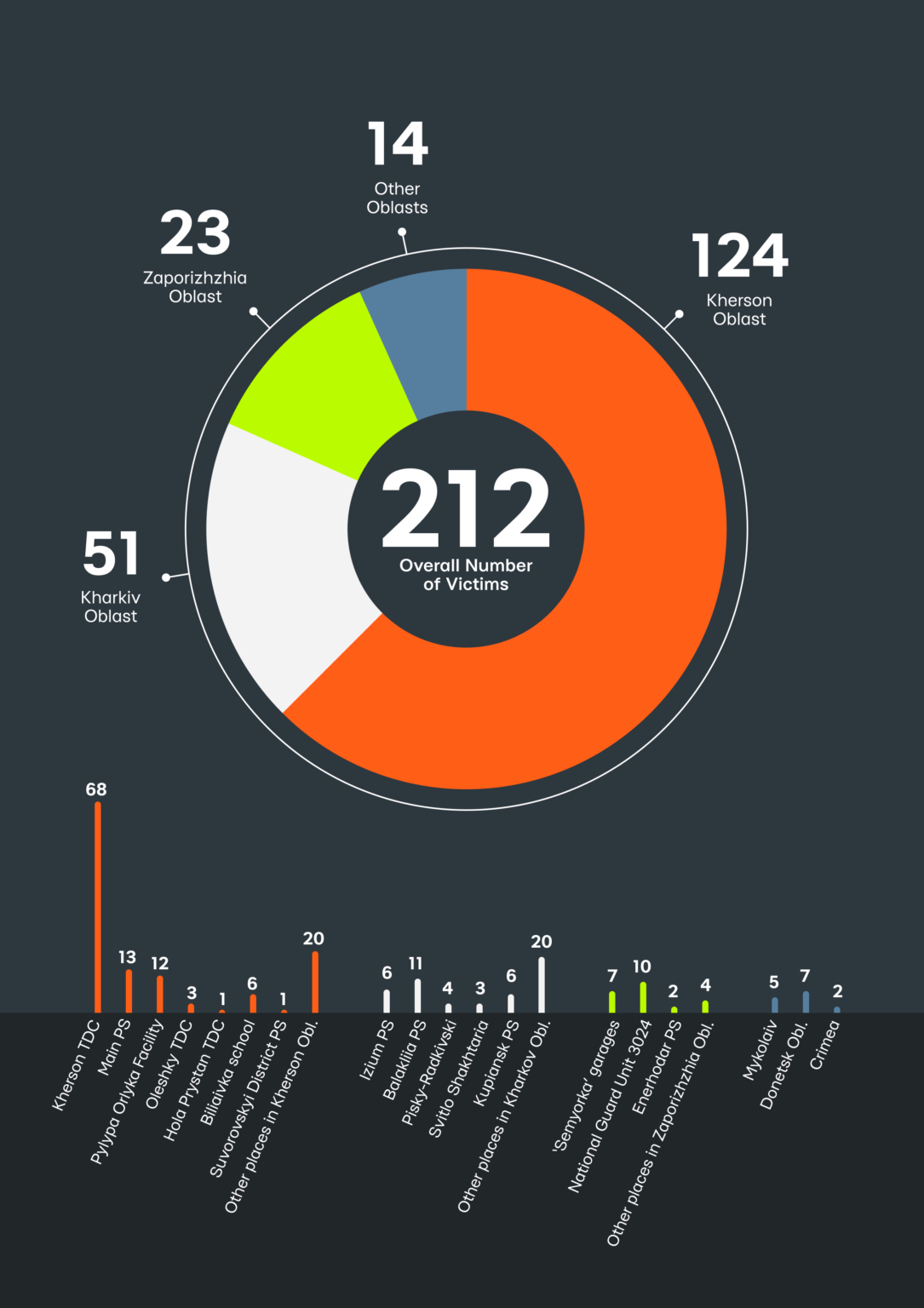
This report draws from survivor and witness testimony and open sources to demonstrate that Russia enacted a widespread and systematic campaign of sexual violence against men in Ukraine. The report’s authors have documented sexual violence by Russian forces against 212 male victims, 125 of whom provided direct survivor statements. Of these, 124 cases were recorded in Kherson Oblast, 51 in Kharkiv Oblast, 23 in Zaporizhzhia Oblast, and 14 in other oblasts¹.
Beyond the numbers, in Section III, the report describes the brutal forms of sexual violence that Russian forces deploy as a matter of established practice, including genital electrocution, rape, and castration. Section IV then describes the network of facilities where Russian forces held and subjected Ukrainian men to sexual violence, with Section V then laying out the organisational structure, including some named perpetrators, that undertook this campaign of torture and humiliation. Section VI qualifies the described conduct as the crimes against humanity of torture and sexual violence under the Rome Statute of the ICC.
The key goals of this conflict-related sexual violence (CRSV) is to control, dominate, and humiliate the victim. This tactic is particularly impactful against men because of the stigma men experience reporting, discussing, and seeking treatment for sexual violence inflicted on them². The purpose of sexual violence is to degrade male victims and injure their sense of masculinity³ – a tactic that is particularly significant in the context of the violently hypermasculine and homophobic culture that pervades Russia’s prison and military systems. As this report demonstrates, Russian forces use this tactic on an unprecedented scale against Ukrainian men.
Sexual violence is part of Russian occupying forces’ everyday toolkit, but its aims do not stop at subjugating a specific victim. By breaking the body and spirit of an individual victim, Russian authorities seek to break societal ties within affected communities and to break the Ukrainian nation as a whole, in pursuance of its overarching goal to erase Ukrainian national identity.
Through this report, Truth Hounds and IPHR wish to amplify the voices of Ukrainian men who survived sexual violence at the hands of Russian occupying authorities and to underscore the extent of conflict-related male sexual violence (CRMSV) perpetrated by Russian forces in Ukraine. At the same time, the authors of the report call on the Ukrainian and foreign governments, including their law enforcement authorities, as well as international organisations and civil society actors to:
- Intensify efforts to pursue accountability for acts of CRMSV committed by Russian forces in Ukraine, including through documenting, investigating, and prosecuting relevant acts and perpetrators;
- Support initiatives and projects aimed at providing medical and psychosocial support to CRMSV survivors, as well as at raising awareness about and de-stigmatising sexual violence against men;
- Employ trauma-informed and victim-centred approaches in all their operations involving CRMSV survivors; and
- Encourage and advocate for progressive legal qualifications of sexual violence to ensure recognition of the distinct nature of such acts.
IPHR and Truth Hounds would like to thank our project partners – Blue Bird, Fight for Rights, and JurFem – for their work in atrocity documentation, litigation, and survivor support. Their efforts have been instrumental in shaping the depth and credibility of this report.
¹ Specifically, five cases in the report come from Mykolaiv Oblast, seven from Donetsk Oblast, and two from Crimea.
² John C Thomas, Jonathan Kopel, ‘Male Victims of Sexual Assault: A Review of the Literature’ (2023) https://pmc.ncbi.nlm.nih.gov/
articles/PMC10135558/.
³ Philipp Schulz, Heleen Touquet, ‘Queering explanatory frameworks for wartime sexual violence against men’ (2020) International Affairs, vol. 96, issue 5, 1169–1187, https://academic.oup.com/ia/article-abstract/96/5/1169/5901389.
Many survivors of sexual violence will bear physical and psychological scars for the rest of their lives. Those who spoke to the authors of this report did so to ensure that perpetrators can be held accountable, and so that others who experienced similar brutality may feel empowered to come forward. It is to these survivors that we dedicate this report.
Methodology and scope
This report focuses on sexual violence that Russian forces perpetrated against Ukrainian civilian men and boys during their full-scale invasion of Ukraine, beginning 24 February 2022 through to the drafting of this report (approximately November 2025). Nevertheless, the report references some incidents from the period of 2014-2022 to explain the context and sequence of practices of the Russian Federation.
The authors of this report have focused on sexual violence against men and boys due to its centrality to Russian efforts to break the back of Ukrainian civilian resistance, seeking to humiliate, emasculate, and break down communal ties among those that Russian forces see as upholding Ukrainian identity. In addition, the authors seek to advance a more progressive understanding of sexual violence against men and boys, which too often lies shrouded behind shame and taboo.
Enabled by the bravery of survivors who have come forward to describe their experiences, the authors aim to impart an understanding of the unique structure and purposes of CRMSV, its near ubiquity during Russia’s full-scale invasion of Ukraine, and the devastating effects on victims. In no way is it meant to reduce the gravity or relativise the scale of sexual violence against women but rather to facilitate a deeper understanding of CRMSV.
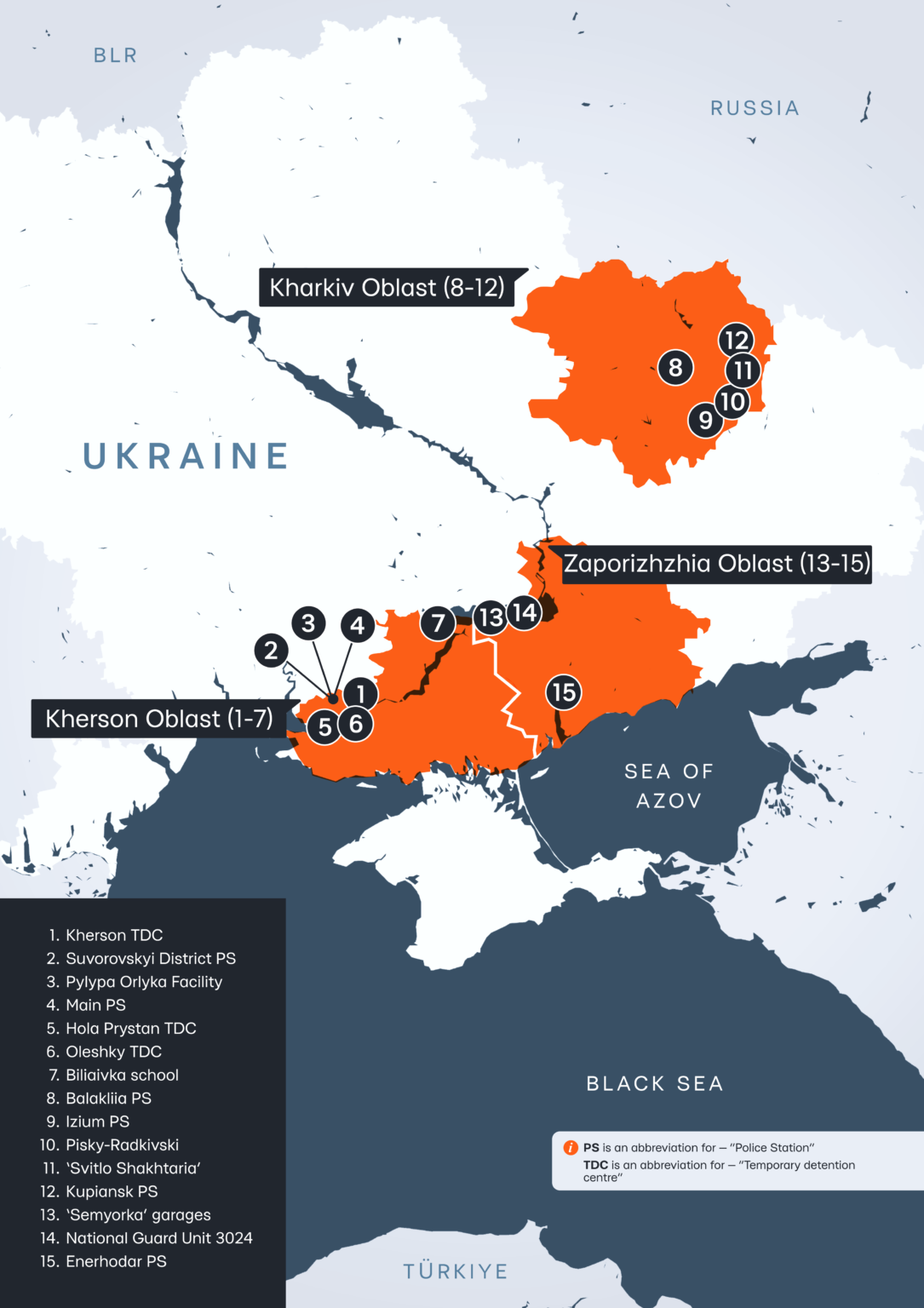
The report mainly focuses on sexual violence against men in the Kherson, Kharkiv, and Zaporizhzhia oblasts because that is where documenters found the most witnesses and survivors willing to come forward. The ongoing occupation of parts of Zaporizhzhia Oblast and fear of re-occupation of parts of Kharkiv Oblast may have prevented more witnesses from sharing their stories, as may have a more general stigma among men concerning discussions of sexual violence they suffered.
At the same time, the report supplements the analysis with individual cases from other regions, including Mykolaiv Oblast, Donetsk Oblast, and Crimea. However, our analysis of CRMSV in these regions was limited and the actual number of victims may be significantly higher. The authors also excluded such areas as the Kyiv and Chernihiv oblasts from the scope of the research because Russian atrocities there have been well documented.
The authors do not purport to present a complete picture of sexual violence against men, but to provide a preliminary account on its scale, brutality, and systematic nature as a prompt for further inquiry. Accordingly, the authors do not believe that the victims attested to in the report encompass the true number of CRMSV victims in any oblast. The true number is likely significantly higher.
The main source of information for this report are the statements of survivors and witnesses collected by Truth Hounds and IPHR documenters during field missions. A small number of victims were also identified through credible open sources⁴. Based on the information obtained, the authors identified two types of victims: individuals who directly provided testimony about their own victimisation (direct testimony) and individuals (either identified or unidentified) whose victimisation was reported by other witnesses (hearsay).
⁴ Credible open sources covered in this report include investigations conducted by reliable media outlets based in the United States and Ukraine, as well as those conducted by international and Ukrainian human rights organisations. The authors identified one potential victim via information reported on social media – this instance is clearly indicated.
About the Authors

Truth Hounds is a full-spectrum accountability organization founded in 2014 in Kyiv, specializing in documenting and investigating international crimes and serious human rights violations in Ukraine and other conflict-affected regions. The organization conducts field investigations, legal research, and analytical studies on international crimes and crimes against humanity.

International Partnership for Human Rights (IPHR) is an independent, nongovernmental organisation founded in 2008. With presences in Brussels, Kyiv, and Warsaw, IPHR works closely with civil society groups in Eastern Europe, the South Caucasus, and Central Asia to raise human rights concerns at the international level and promote respect for the rights of vulnerable communities. IPHR has been documenting atrocity crimes committed in the context of Russia’s war on Ukraine since 2014 and has been using collected evidence for accountability purposes.