
View the study in PDF format
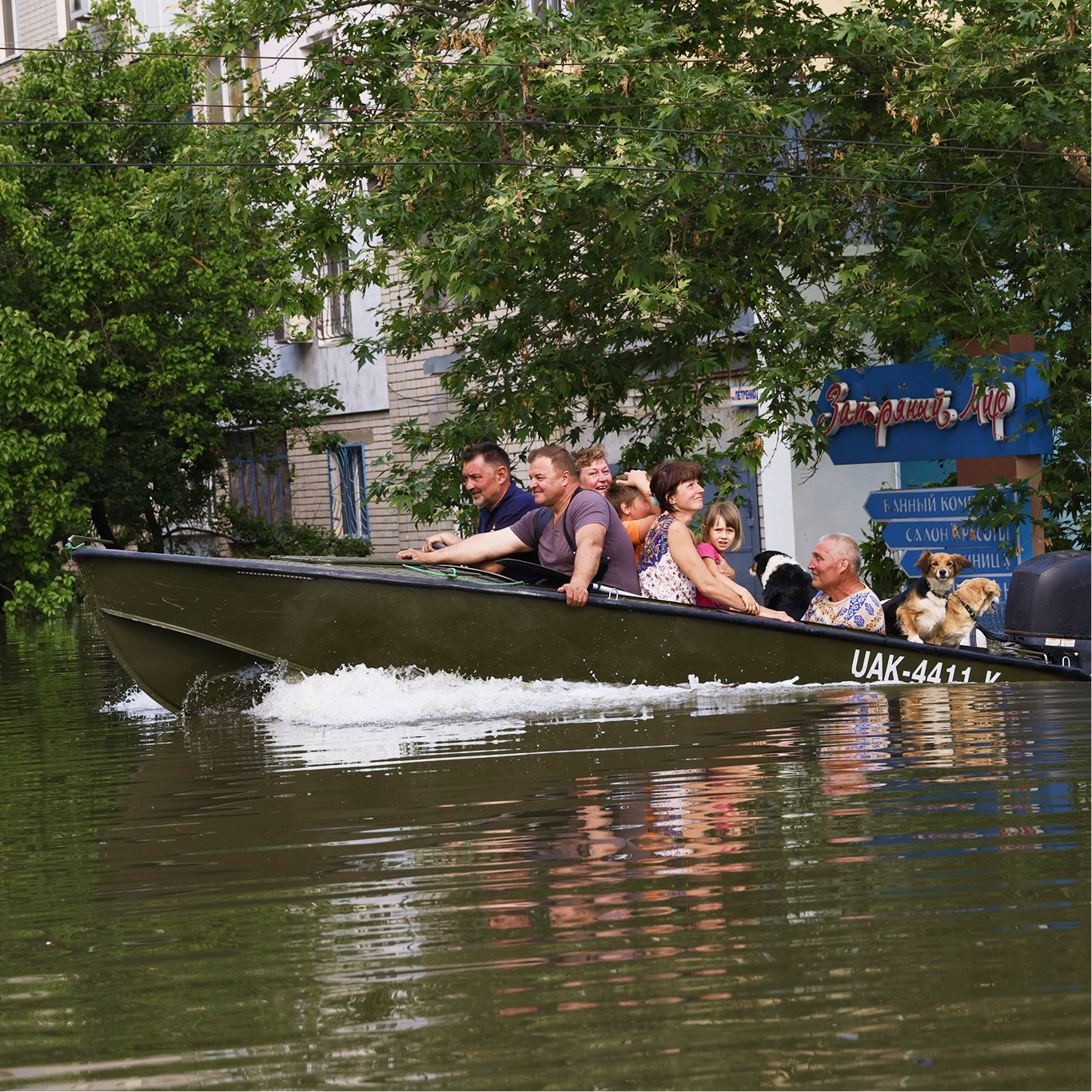
Volunteers evacuate civilians from the flooded areas of Kherson by a motorboat. The signboard in the background says «Lost World». 7 June, 2023.
Photo by Alex Babenko/Getty Images
Executive Summary
On June 6, 2023, the destruction of the Kakhovka Hydroelectric Power Plant (HPP) unleashed a vast humanitarian and environmental disaster across southern Ukraine. Floodwaters swept through communities on both banks of the Dnipro River, submerging homes, trapping civilians, destroying livelihoods, and leaving thousands of people in urgent need of rescue, food, water, medical care, and evacuation. The disaster struck a frontline area where Ukrainian and Russian forces are separated only by the Dnipro River. That fact shaped every hour of the emergency response.
Russia launched its full-scale invasion of Ukraine on February 24, 2022, expanding a war that began in 2014 with Russia’s occupation of Crimea and the outbreak of fighting in eastern Ukraine. In June 2023, Russian forces controlled parts of Kherson Oblast, namely areas on the left bank of the Dnipro River. Between June 6 and mid-June 2023, the Lower Dnipro area became the site of the largest emergency operation of Russia’s war against Ukraine.
This report examines how Russian forces and occupation authorities disrupted, obstructed, and endangered volunteer emergency rescue efforts after the destruction of the Kakhovka dam. It focuses on the people who assisted state emergency services and saved lives in the days that followed: Ukrainian Red Cross Society (URCS) teams, NGO staff, and ordinary local residents. Available evidence indicates that Russian forces’ and occupation authorities’ actions in response to the destruction of the Kakhovka HPP raise serious concerns under international humanitarian law (IHL), including potential violations of the rules protecting civilians, humanitarian relief, civil defense, and people living under occupation.
On the Ukrainian-controlled right bank of the Dnipro, emergency responders and volunteers began evacuations within hours. They supported overburdened state services by directly participating in rescue operations, providing targeted assistance to specific populations, such as the elderly and people with disabilities or mobility issues, and coordinating among actors.
Russian forces repeatedly shelled areas where these rescue operations took place. Volunteers interviewed by Truth Hounds described mortar and artillery fire near evacuation points, boats, flooded residential streets, and clearly marked emergency responders. One such incident, documented for this report, occurred around Kherson’s Korabelna Square, one of the city’s most important evacuation points. It injured nine civilians, including two State Emergency Service (SES) responders and a police officer. In general, volunteers said that uniforms and humanitarian markings did not protect them. In some cases, they feared that visible markings made them more vulnerable.
These attacks slowed evacuations, forced responders to suspend or reroute missions, left civilians waiting in flooded homes, and deepened panic among people already trapped by rising water. Even when shelling did not kill or injure responders, it forced them to make impossible choices about when to move, whom to rescue first, and how much risk to accept.
On the Russian-occupied left bank, where the flood caused the greatest damage, Russian occupation authorities failed to organize an adequate emergency response in the crucial first days after the dam’s destruction. Witnesses told Truth Hounds that local residents had to rescue one another because official help did not arrive. Community members used private boats, inflatable mattresses, and improvised tools to rescue people stranded on rooftops, in attics, and inside collapsing homes without the benefit of trained rescue personnel. Telegram chats and especially personal networks served as indispensable means of communication, especially when mobile networks were not functioning properly.
Witnesses shared how Russian forces and occupation authorities not only failed to provide an effective rescue operation, but in some cases obstructed civilian rescue efforts and downplayed the scale of the disaster in public communication while civilians remained trapped. Russian forces and occupation authorities confiscated boats and engines, restricted movement, blocked access to flooded areas, prevented some outside volunteers from entering affected towns, and, in some cases, conditioned help on possession of Russian passports or payment.
The human cost of this tragedy remains difficult to calculate, especially in areas under Russian occupation. Ukrainian authorities reported 32 deaths and 39 missing people on the right bank one year after the disaster. The true toll on the left bank remains unknown because independent monitors and humanitarian organizations lack access to the occupied territories.
The Kakhovka case shows how the weaponization of water can become even more deadly when a party to an armed conflict attacks or obstructs emergency response. The flood created immediate danger, but the harm was not fixed at the moment of detonation. It unfolded during a response window in which rescue, evacuation, medical care, and humanitarian assistance could still save lives. Russian attacks and obstruction kept responders from making effective use of that window on both banks of the Dnipro, magnifying and extending the danger well beyond what the breach itself produced.
IHL requires parties to a conflict to distinguish civilians from combatants, to take constant care to spare civilians, and to facilitate humanitarian relief for civilians in need. It also protects humanitarian personnel and civil defense operations. Russian forces violated these basic principles when they attacked areas where emergency responders and volunteers carried out evacuations and when they interfered with civilian rescue efforts in occupied territory. The documented pattern also raises serious concerns that Russian forces may have used disaster-induced vulnerability as a weapon, turning civilians’ urgent need for rescue into another harm.
Read in Ukrainian
Truth Hounds compiled this report with the support of donors

This publication was produced with the generous support of the Howard G. Buffett Foundation. Its contents are the sole responsibility of Project Expedite Justice and Truth Hounds.
Recommendations
To accountability and justice actors at the national and international levels
- Continue systematic documentation of attacks on emergency responders and obstruction of rescue operations during the Kakhovka response, including the cases on the occupied left bank, to build evidentiary records capable of supporting criminal proceedings at the national and international levels.
- In investigations into the destruction of the Kakhovka HPP, examine Russian forces’ and occupation authorities’ conduct during the response phase, including attacks on responders on the right bank and obstruction of rescue on the occupied left bank. This conduct should form part of an integrated factual record, as it may indicate an intent to maximize civilian harm or a failure to prevent foreseeable harm during the response phase.
To the United Nations
- Use existing mechanisms, including the Human Rights Council, OHCHR, and the Independent International Commission of Inquiry on Ukraine, to examine the conduct of Russian forces and occupation authorities during the Kakhovka response as part of broader monitoring of attacks on civilians and humanitarian operations;
- Use the platforms of the Secretary-General, the Human Rights Council, and other relevant bodies to call, where appropriate, for time-limited humanitarian pauses to enable search-and-rescue and essential humanitarian assistance.
To national and international civil defense and humanitarian organizations
- Integrate lessons from the Kakhovka response into training for operations during armed conflict, especially emergencies involving destroyed infrastructure and large-scale environmental harm. Training should address how professional services can coordinate with spontaneous civilian volunteer networks in areas exposed to shelling.
To the academic, research, and human rights communities
- Examine attacks during large-scale environmental shocks as a distinct object of study within the broader literature on attacks on first responders. Such research should aim to identify recurring patterns across conflicts, develop indicators to distinguish incidental from deliberate disruption, and clarify the relationships between the various provisions of IHL that apply in such cases;
- Investigate the actions of the parties to a conflict within the “response window” — the period during which an emergency has not yet reached the peak of its destructive impact. In particular, to analyze the extent to which such actions facilitated or hindered the conduct of rescue operations, the delivery of humanitarian assistance, and the minimization of harm to civilian population, as well as which legal and operational frameworks are capable of ensuring the effective use of this period amid ongoing hostilities.