
Out of Control: Moving Target Attacks in Ukraine and the Law of Armed Conflict
Executive Summary
On June 27, 2023, a Russian cruise missile struck the Ria Lounge cafe, a popular pizza restaurant in central Kramatorsk, Ukraine, killing 13 people and injuring 60. Russian forces claimed the strike had hit a temporary military command post of the 56th Motorized Infantry Brigade and killed two generals, up to 50 officers, and up to 20 foreign mercenaries. The available evidence tells a different story. The cafe was operating as an ordinary public restaurant filled with customers across two levels that day. Military personnel were temporarily present, off-duty and unarmed, attending a birthday celebration alongside roughly equal numbers of civilians in the basement’s private event space. Of the 13 people killed, only two were active servicemen. The basement room, which Russian forces allegedly targeted, remained essentially intact.
This strike captures the central concern of this report. Russian forces used a weapon they could not recall on a target whose presence they could not verify at the time of impact, in a location where civilian harm was entirely foreseeable. Does such a strike comply with international humanitarian law?
Truth Hounds investigated the Kramatorsk attack and concluded that it constituted a war crime as an indiscriminate attack under art. 8(2)(b)(iv) of the Rome Statute. This assessment rested on several factors, including a gap of more than two hours between the informant’s last known site observation and the moment of impact. The missile’s estimated flight time of 9 to 15 minutes meant that, once launched, no verification, redirection, or recall was possible. The use of a cruise missile with an approximately 500-kilogram warhead against a temporary target in a densely populated civilian area was itself sufficient, in Truth Hounds’ assessment, to establish the attacker’s knowledge of the likelihood of excessive civilian harm.
The fact pattern of the Kramatorsk strike is not an isolated case in Russia’s war in Ukraine. This report examines three other incidents in which Russian forces struck civilian locations on the basis of a temporary military presence, each involving a precision-guided cruise missile with a significant launch-to-impact time interval and substantial destructive effects.
The report uses these incidents to show how delayed-impact attacks against temporary alleged targets — referred to as “moving target attacks” — in civilian settings raise serious concerns under existing international humanitarian law and warrant investigative scrutiny.
Read in Ukrainian
Truth Hounds compiled this
report with the support of our donor.

This publication was produced with the generous support of the Howard G. Buffett Foundation. Its contents are the sole responsibility of Project Expedite Justice and Truth Hounds.

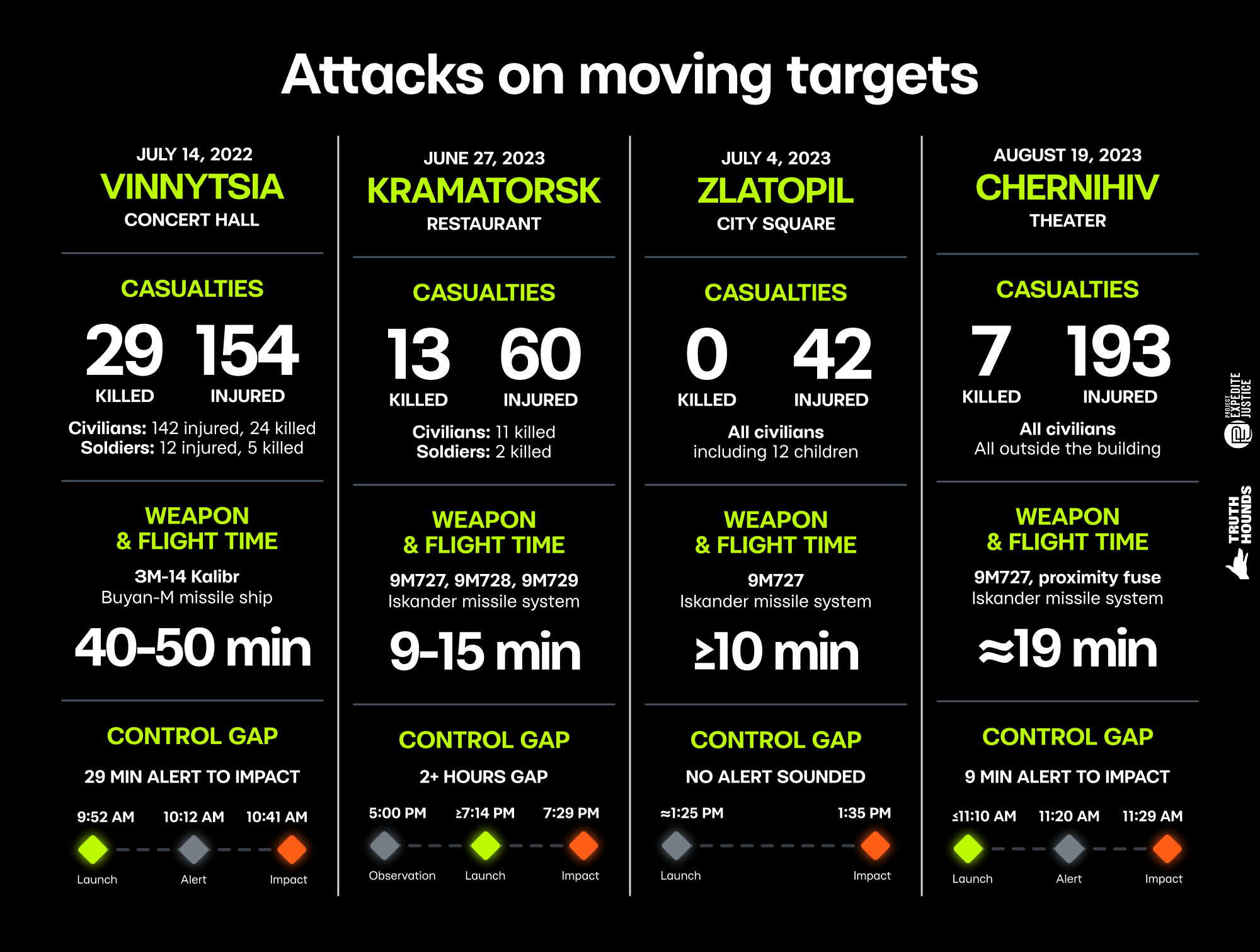
On July 14, 2022, three Kalibr cruise missiles struck the center of Vinnytsia, a city in central-western Ukraine in Vinnytsia Oblast; two missiles hit the House of Officers, and the third hit a nearby parking area.
Twenty-nine people were killed, including five servicemen and three children; at least 154 were wounded. Russian forces claimed the strike targeted a gathering of Air Force command and foreign weapons suppliers. A working meeting had indeed been scheduled for that morning at the venue. By 9:52 a.m., warnings of missile launches from the Black Sea were already circulating across southern Ukraine. A formal air-raid alert in Vinnytsia followed at 10:12 a.m. The missiles struck at 10:41 a.m., approximately 40 to 50 minutes after launch.
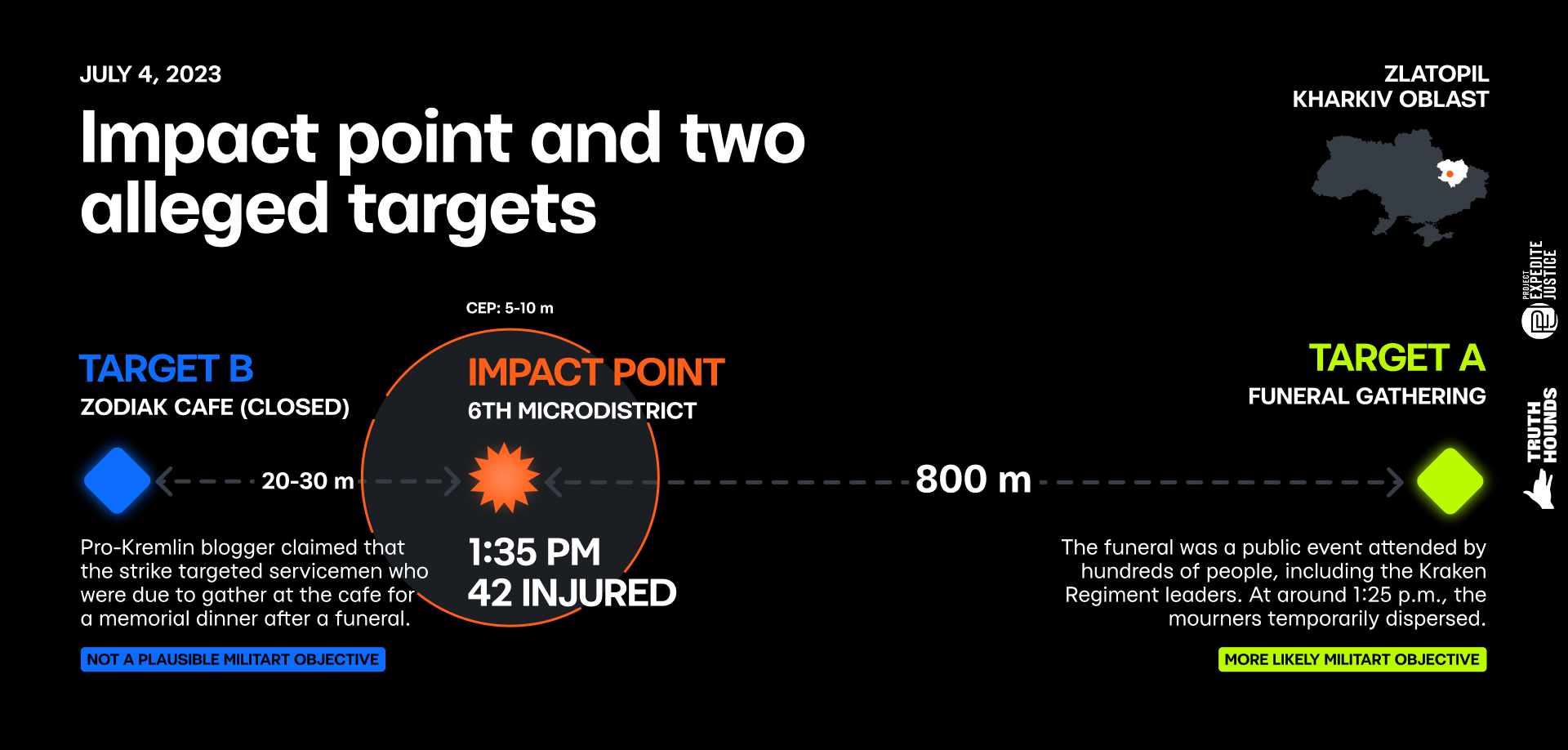
On July 4, 2023, a cruise missile struck a residential area of Zlatopil in Kharkiv Oblast during a public funeral for a serviceman of the Kraken Regiment of the Ukrainian military.
Forty-two civilians were wounded, including 12 children. The missile landed approximately 800 meters from the central square where the ceremony had been scheduled, far beyond any plausible margin of targeting error for the weapon type. By the time of the strike, the funeral gathering had already partly dispersed. Russian Telegram channels claimed the target was the Zodiak cafe; residents confirmed it had been closed for years. The Russian Ministry of Defense never issued a public statement about the target of the attack.
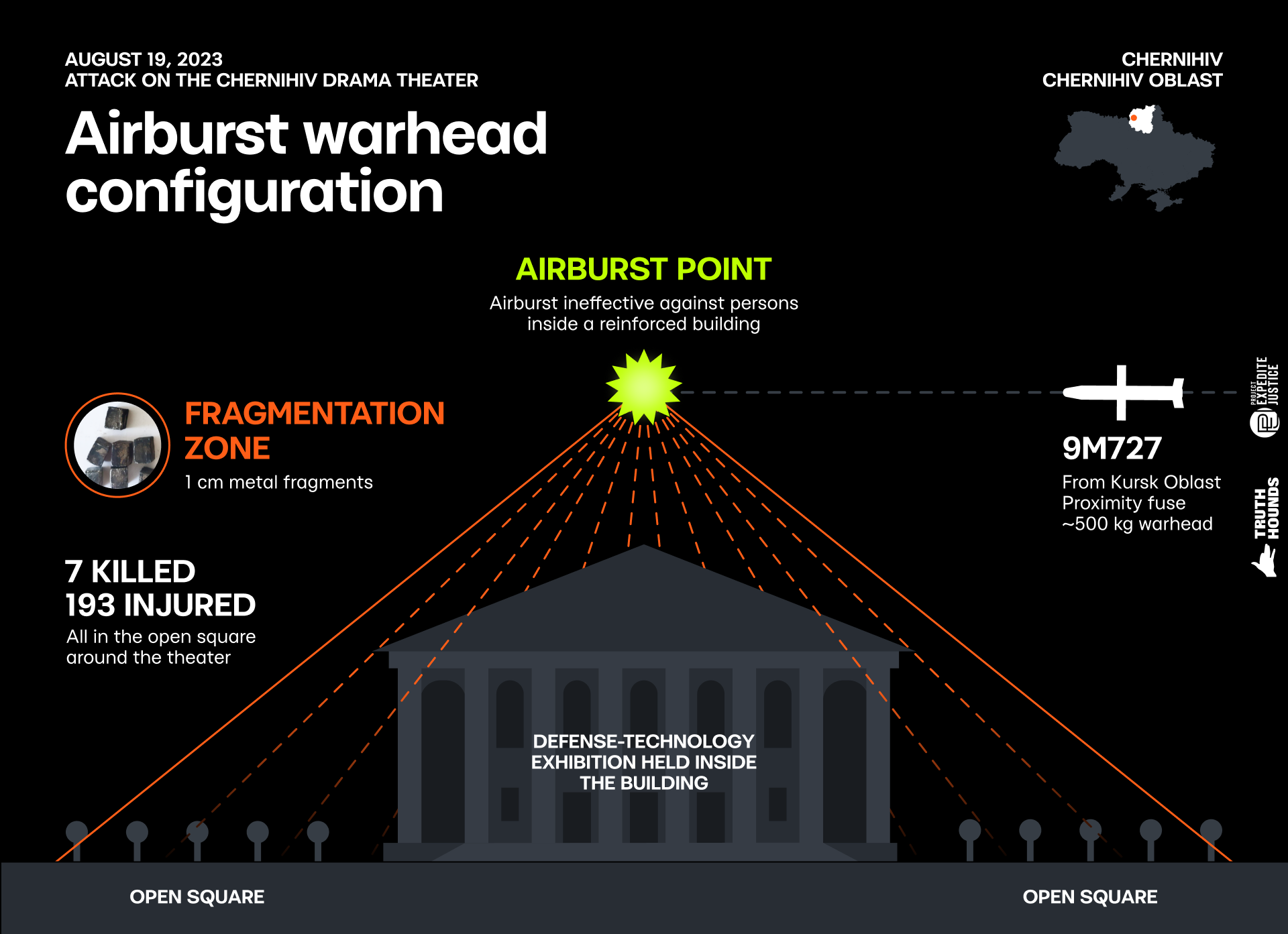
On August 19, 2023, a cruise missile struck the Drama Theatre in central Chernihiv in northern Ukraine, killing 7 and injuring 193.
That day, civilian NGOs were hosting a defense-technology exhibition in the building. The missile, which was most likely launched from Kursk Oblast at around 11:10 a.m., hit at 11:29 a.m. It was configured with a proximity fuse, which caused it to detonate in mid-air above the building. The airburst spread lethal fragments across the open square outside, rather than concentrating the blast on people inside. All seven fatalities occurred outside.
These incidents involved different locations, alleged targets, weapons configurations, and evidentiary records, but they share a common pattern.
Russian forces used precision-guided weapons with significant launch-to-impact time intervals and substantial destructive effects against temporary or time-sensitive military presence or activity in civilian environments. In each case, civilians were foreseeably present, the intended target’s location could change before impact, and the attacker had no ability to verify, redirect, or cancel the strike after launch. That lack of control sits at the center of the legal analysis.
International humanitarian law requires parties to distinguish between civilians and combatants, and between civilian objects and military objectives. It prohibits attacks expected to cause excessive civilian harm in relation to the concrete and direct military advantage anticipated. It requires those who plan or decide on attacks to do everything feasible to verify targets, choose means and methods that minimize civilian harm, and cancel or suspend attacks when the legal conditions for attack no longer exist. It also prohibits indiscriminate attacks, including attacks not directed at a specific military objective and attacks whose effects cannot be limited as required by law.
For the Kramatorsk attack, Truth Hounds concluded it was a war crime. For Vinnytsia, Zlatopil, and Chernihiv, the available evidentiary record remains insufficient to support equivalent legal conclusions at this stage; however, each raises serious concerns regarding distinction, proportionality, and precautions that warrant further investigation. In Vinnytsia, at least 29 minutes of advance warning undermined any reliable claim that the alleged target would still be present at impact. In Zlatopil, the missile either missed the alleged target by 800 meters and after the gathering had dispersed, or targeted a nearby cafe where no military gathering could be substantiated. In Chernihiv, a pre-launch warhead choice maximized harm to civilians outside the building while providing limited effectiveness against the alleged objective within it.
This report does not propose a new legal category under international humanitarian law. Rather, it uses the term “moving target attacks” to identify a recurring fact pattern that existing law should address with greater clarity and rigor. The central concern is the attacker’s control. A weapon that cannot be recalled or redirected, directed at a target that may move, disperse, or lose military significance before impact, makes pre-launch verification decisive. Technical precision does not resolve that problem. A missile may hit its programmed coordinates and still raise serious legal concerns if those coordinates no longer correspond to a lawful military objective, or if the attacker failed to account for civilians foreseeably at risk.
This report analyzes the legal questions these attacks raise, identifies indicators that investigators and prosecutors should examine, and encourages military actors, legal advisers, accountability mechanisms, and monitoring bodies to treat attacks against temporary targets in civilian settings as a distinct operational problem requiring careful scrutiny. This matters not only for accountability after the fact but also for preventing future attacks in which the choice of target, timing, and weapon makes significant civilian death and injury foreseeable from the outset.
Recommendations
To Ukrainian authorities:
- Further investigate the attacks in Kramatorsk, Vinnytsia, Zlatopil, and Chernihiv for possible prosecution as war crimes, with particular attention to the targeting chain, intelligence used, weapon selection, and the launch-to-impact interval in each case.
- Prioritize, more broadly, cases involving attacks on civilian locations where the alleged military justification rested on a temporary or otherwise non-operational military presence.
- Preserve technical evidence relevant to timing and targeting, including weapon remnants, crater analysis, CCTV footage, air alert records, missile flight-path and trajectory data, launch geolocation data, and intercepted communications.
- Share relevant evidence with international partners, investigative mechanisms, and national authorities exercising universal jurisdiction.
To states supporting Ukraine’s accountability efforts:
- Fund forensic, geolocation, and OSINT investigations into attacks on civilian locations in Ukraine allegedly justified by temporary military presence, including technical reconstruction of launch-to-impact timelines, weapon effects, and attacker control.
- Support secure evidence preservation and training for Ukrainian and international investigators on time-sensitive targeting, civilian harm analysis, and the legal significance of target mobility.
To foreign governments and law enforcement agencies:
- Investigate, including under universal jurisdiction where possible, attacks on civilian locations justified by reference to the temporary presence of military personnel.
- Ensure that legal assessments address the temporary nature of the alleged target, the foreseeability of civilian presence, and the effect of the launch-to-impact gap on attacker control, and avoid treating technical precision alone as evidence of lawfulness.
- Preserve and share evidence relevant to attacks of this kind, including open-source material, targeting-chain information, and technical assessments, and support cooperation with Ukrainian authorities and international investigative mechanisms.
To the United Nations (UN) and international monitoring bodies:
- Document incidents in Ukraine in which strikes on civilian locations are justified by reference to a temporary military presence, applying consistent indicators including the character of the location, the weapon used, the launch-to-impact time interval, and post-strike justification narratives.
- Identify and report recurring patterns involving weapons with significant destructive effects or flight time used against temporary or mobile alleged targets in civilian settings.
- Encourage the Office of the High Commissioner for Human Rights (OHCHR), the International Committee of the Red Cross (ICRC), and relevant United Nations (UN) expert mechanisms to develop practical guidance on how IHL applies to delayed-impact attacks against time-sensitive or mobile targets, including the duty to verify the continued presence of a military objective.
- Clarify in any public reporting that the presence of military personnel at a civilian location does not automatically remove civilian protection or relieve the attacker of the duty to verify, reassess, cancel, or suspend an attack.
To the International Criminal Court (ICC) and United Nations investigative mechanisms:
- In examining attacks on civilian locations in Ukraine, assess whether the attacker had a reasonable basis to believe the alleged military objective would still be present at impact, and investigate the full targeting chain, including target selection, intelligence validation, weapon selection, and launch timing.
- Consider whether attacks of this kind reflect an operational practice, targeting policy, or pattern of conduct relevant to criminal responsibility.
- Investigate the full targeting chain, including target selection, intelligence validation, weapon selection, approval procedures, launch timing, battle damage assessment, and post-strike reporting.
- Evaluate the attacks under distinction, proportionality, and precautions in attack, and avoid treating technical precision alone as evidence that the attack was lawful.
To the International Committee of the Red Cross (ICRC):
- Engage with the legal and operational questions raised by attacks against temporary or mobile alleged military objectives in civilian environments, as a matter that requires dedicated attention within existing IHL frameworks.
- Convene expert discussions bringing together military practitioners, legal advisers, and IHL scholars to clarify how the principles of distinction, proportionality, and precautions in attack apply to delayed-impact weapons used against time-sensitive or mobile targets, including on the duty to verify the continued presence of a military objective where the weapon has a significant launch-to-impact interval.
- Share the findings of any such expert process through the ICRC’s standard dissemination channels, including its engagement with armed forces and national IHL committees.
To military actors and military legal advisers:
- Apply heightened scrutiny to any attack against a temporary or mobile target located in a civilian environment.
- Require renewed verification whenever there is a meaningful delay between target identification, launch authorization, and expected impact.
- Build clear procedures for delaying, canceling, redirecting, or reassessing an attack when the target may move, disperse, or cease to be a lawful military objective before impact.
- Refrain from proceeding when the attacker cannot maintain sufficient control over the target or the effects of the attack to comply with the principles of distinction, proportionality, and precautions in attack.
- Ensure that the choice of means and methods reflects foreseeable civilian harm in the specific circumstances, not the weapon’s technical precision alone.
- Integrate delayed-impact and time-sensitive targeting scenarios into military doctrine, training, legal review, and civilian harm mitigation exercises.
To legal scholars, IHL experts, and research institutions:
- Engage with moving target attacks as an analytical framework for examining existing IHL obligations.
- Use case-based research to clarify how target mobility affects the attacker’s legal obligations to verify, reassess, cancel, or suspend an attack before impact, and to identify practical indicators that investigators can use to assess the attacker’s knowledge, target volatility, foreseeable civilian harm, and feasible alternatives.
To digital platforms and technology companies:
- Preserve online content related to attacks on civilian locations in Ukraine, including official Russian statements, affiliated media narratives, videos, photographs, metadata, and posts by military or political actors.
- Respond promptly to lawful preservation requests from credible investigators, prosecutors, international mechanisms, and civil society documentation groups.
- Maintain secure access to removed, restricted, or de-amplified content that has potential evidentiary value for accountability, subject to privacy, safety, and due process safeguards.
Methodology
Project Expedite Justice (PEJ) and Truth Hounds (TH) jointly prepared this report based on first-hand testimonies, desk research, open-source intelligence (OSINT), a review of existing reports and legal materials, and the analysis of publicly available Russian official statements and other sources.
Investigative Findings
First-Hand Testimonial Evidence
The factual account of the Kramatorsk attack in Chapter 1 rests primarily on survivor and eyewitness testimonies, which TH gathered for an investigation into the June attack published in November 2023. TH interviewed 22 witnesses and survivors, including ten people who were inside the Ria Lounge at the time of the strike or arrived at the scene shortly afterward. Those interviewed came from a range of backgrounds, including journalists, volunteers, paramedics, and former restaurant employees. TH collected the first accounts remotely the day after the attack, and interviewed five of the 22 witnesses in person during a field mission to Kramatorsk and Bilenke in August 2023. All interviews were conducted in accordance with TH’s documentation methodology and code of ethical practice, following the do-no-harm principle. First-hand testimonial evidence was not available for all of the additional incidents examined in Chapter 2; that chapter relies primarily on the open-source materials described below. The report also draws on three witness testimonies concerning the Zlatopil attack, collected in July 2023.
Open-Source Research and Technical Analysis
For the Kramatorsk attack, TH analyzed satellite imagery from Planet, Maxar, and Google Earth, and used OSINT tools including Paliscope and PimEyes. TH additionally conducted technical calculations based on missile speed and distance parameters to identify the possible weapons used and establish the probable launch area. For the additional 3 incidents, TH reviewed publicly available information, including photos and videos, official statements from both parties, and related social media postings, such as on Telegram.
Where available, we reviewed Russian official statements for each incident to identify the targeting rationale claimed by Russian officials. Where no such statements were available, we reviewed posts published by Russian military and war-related Telegram channels to analyze the narratives advanced regarding the attacks and the possible reasons presented for them.
Telegram monitoring channels served as additional sources for reconstructing missile flight paths and strike timelines in near-real time, aggregating reports from regional air alert systems and, in some cases, sources with access to operational information regarding airborne threats. However, their methodologies and sourcing practices are not always transparent, and information may be edited, deleted, or updated as events develop. Accordingly, Telegram-sourced data was treated as preliminary evidence only, cross-referenced where possible, and flagged or excluded where information remained unconfirmed or was subsequently contradicted.
Selection of Incidents
TH selected the three cases examined in Chapter 2 on the basis of criteria developed from the investigation into the Kramatorsk missile strike, in consultation with PEJ. This report does not intend to draw definitive legal determinations in each selected case. The selected incidents are included to illustrate a recurring pattern of attacks in Russia’s war in Ukraine that warrants further scrutiny, particularly in light of the civilian casualties associated with these strikes.
We selected incidents that met the following criteria:
- Weapon type: The attack involved a cruise missile or another precision-guided weapon capable of being directed at a specific target and producing significant destructive effects in the area of impact;
- Foreseeability of civilian presence: The strike’s location was of a civilian character, situated within a civilian environment, and the presence of civilians was foreseeable at the time of the attack;
- Temporary military presence: There were indications of the presence of military personnel or military assets at or in the immediate vicinity of the location that was hit, where such presence appears to have been temporary or transient and not linked to any ongoing military use of the location;
- Significant launch-to-impact interval: The weapon used had a launch-to-impact interval* of approximately 10 minutes or more. This report treats that interval not as a legal threshold, but as a practical indicator of a meaningful launch-to-impact gap during which a temporary or mobile target may change position, disperse, or no longer be present at the anticipated time of impact;
- Civilian casualties: The attack resulted in civilian casualties; and
- Russian claims of military justification (optional; not available for all selected incidents): Russian official sources stated that the attack targeted a military objective (in particular, the presence of Ukrainian military personnel).
* The launch-to-impact interval estimate, which coincides with the weapon’s flight time, is calculated for the purposes of this report using the formula t = d / v, where t is flight time, d is the straight-line (great-circle) distance between the approximate launch area and the point of impact, and v is the cruise speed of the weapon type. Distances were measured using the distance-measurement tool in Google Earth. Where cruise speed is expressed in meters per second, flight time in minutes is calculated as (d × 1,000 / v) / 60; where it is expressed in kilometres per hour, as (d / v) × 60. These calculations are deliberately conservative and are intended as indicative lower estimates rather than precise figures. They assume a direct flight path, whereas cruise missiles in fact gain and lose altitude and may maneuver in flight, increasing both the distance travelled and the actual flight time. They also rely on nominal published cruise speeds and, in most cases, on an assumed rather than independently verified launch location. The actual flight time is therefore likely to be equal to or greater than the figure stated, which does not undermine, and if anything reinforces, the report’s findings regarding the launch-to-impact interval.
* The launch-to-impact interval estimate, which coincides with the weapon’s flight time, is calculated for the purposes of this report using the formula t = d / v, where t is flight time, d is the straight-line (great-circle) distance between the approximate launch area and the point of impact, and v is the cruise speed of the weapon type. Distances were measured using the distance-measurement tool in Google Earth. Where cruise speed is expressed in meters per second, flight time in minutes is calculated as (d × 1,000 / v) / 60; where it is expressed in kilometres per hour, as (d / v) × 60. These calculations are deliberately conservative and are intended as indicative lower estimates rather than precise figures. They assume a direct flight path, whereas cruise missiles in fact gain and lose altitude and may maneuver in flight, increasing both the distance travelled and the actual flight time. They also rely on nominal published cruise speeds and, in most cases, on an assumed rather than independently verified launch location. The actual flight time is therefore likely to be equal to or greater than the figure stated, which does not undermine, and if anything reinforces, the report’s findings regarding the launch-to-impact interval.

Methods of Legal Analysis
The legal analysis draws on Additional Protocol I to the Geneva Conventions (AP I) and desk research of relevant legal literature, reports by international bodies and civil society organizations, and applicable case law from international criminal tribunals. This includes jurisprudence from the International Criminal Tribunal for the former Yugoslavia (ICTY), the Rome Statute of the ICC and its Elements of Crimes, the ICRC Commentary on AP I, the ICRC Study on Customary International Humanitarian Law, and the report of the Independent Commission of Inquiry on the 2014 Gaza Conflict. The analysis also engages with academic scholarship on the conduct of hostilities, the use of destructive weapons in civilian areas, and the legal standards applicable to target selection and verification.
Limitations
For the incidents examined in Chapter 2, the factual basis primarily rests on OSINT investigation. Unlike the Kramatorsk investigation, which drew on direct interviews with eyewitnesses and survivors, first-hand testimonies were not available for all of the additional incidents examined in this report. The analysis, therefore, relies primarily on publicly available documentation, which in some cases is incomplete or does not permit verification of all relevant factual circumstances. Where this affects the conclusions that can be drawn, it is noted in the relevant sections.
Missile flight times cited in this report are drawn from two sources. Some are taken from investigative materials that the authors were unable to verify independently; others were calculated by the authors from publicly available information and should be regarded as indicative rather than definitive. In both cases, the figures are best treated as approximate.
About the Authors

Truth Hounds is a full-spectrum accountability organization founded in 2014 in Kyiv, specializing in documenting and investigating international crimes and serious human rights violations in Ukraine and other conflict-affected regions. The organization conducts field investigations, legal research, and analytical studies on international crimes and crimes against humanity.

Project Expedite Justice is a non-profit organization whose core mission is to bring justice to conflict-affected communities, including those impacted by genocide, war crimes, and crimes against humanity. Since April 2022, PEJ has worked to ensure accountability for communities affected by the Russian invasion. We document international crimes and harms throughout Ukraine. Our efforts have included providing custom expert- and technical-based support, direct investigative activities, information collection, and preparation of legal analysis packages for judicial stakeholders.